Under the Volcano’s Shadow: Naples’ Secret Geological Wonders
Nestled beneath the watchful gaze of Mount Vesuvius, Naples hides surreal landscapes most travelers never see. Beyond pizza and Pompeii, its underground tunnels, fossil-rich cliffs, and steaming fumaroles reveal Earth’s raw power. While many visitors come for ancient ruins and coastal charm, few realize that beneath their feet lies a dynamic geological story still unfolding. From subterranean cities carved in volcanic tuff to coastal cliffs that rise and fall with underground forces, this region is a living laboratory of natural forces. This journey explores the hidden wonders shaped by fire and time—where science, history, and adventure converge beneath the shadow of one of the world’s most famous volcanoes.
The Living Volcano: Vesuvius and Its Unseen Influence
Mount Vesuvius looms over the Bay of Naples not just as a scenic backdrop but as a constant geological presence. Though it has been in a state of relative quiet since its last eruption in 1944, it remains one of the most closely monitored volcanoes on Earth. Classified as a stratovolcano, Vesuvius is known for its explosive eruptions, the most infamous occurring in 79 AD when it buried the cities of Pompeii and Herculaneum under meters of ash and pumice. That catastrophic event, recorded by Pliny the Younger, offers one of the earliest detailed accounts of a volcanic eruption in human history and gave rise to the term “Plinian eruption,” used by volcanologists worldwide to describe powerful, column-forming blasts.
Yet Vesuvius is more than a relic of past destruction. Its continued activity subtly shapes the surrounding landscape even in dormancy. The volcano sits atop a complex system of magma chambers that generate frequent seismic tremors, monitored daily by the Vesuvius Observatory. These small movements indicate that pressure continues to build beneath the surface. The region's soil, enriched by millennia of volcanic deposits, is exceptionally fertile—supporting lush vineyards, orchards, and the famed San Marzano tomatoes used in Neapolitan cuisine. This fertility, born from destruction, illustrates nature’s capacity for renewal and balance.
The topography of the region has also been directly sculpted by repeated eruptions. Layers of lava, ash, and pyroclastic flow have built up over time, forming hills, valleys, and plateaus that define the local terrain. The presence of Vesuvius has influenced settlement patterns for thousands of years, with ancient civilizations drawn to the rich soil despite the known risks. Today, over three million people live in the volcano’s shadow, making it the most densely populated volcanic region on the planet. This coexistence between human life and geological hazard underscores a profound relationship between people and the land—one rooted in both respect and resilience.
For travelers, understanding Vesuvius means more than visiting a crater. It involves recognizing the ongoing processes that shape daily life in Campania. Guided hikes to the summit offer panoramic views of the bay and a chance to peer into the active cone, where sulfur vents whisper of subterranean heat. Interpretive signs and visitor centers provide accessible insights into volcanic science, making the experience both educational and awe-inspiring. Safety protocols are strictly enforced, ensuring that exploration remains responsible and informed. Vesuvius is not just a monument to the past; it is a living reminder of Earth’s restless energy.
Beneath the City: Naples’ Vast Underground Network
Far below the bustling streets of Naples lies a hidden world that stretches for over 150 kilometers—an intricate network of tunnels, chambers, and caverns carved from soft volcanic rock. This subterranean labyrinth, largely formed from *tufo giallo napoletano*, was initially excavated by the ancient Greeks and expanded during Roman times for use as aqueducts, cisterns, and storage spaces. Over the centuries, these spaces served many purposes: early Christian burial sites, monastic refectories, and even air raid shelters during World War II. Today, only a fraction of this underground maze is accessible, yet what remains offers a fascinating glimpse into how geology and human history are deeply intertwined.
The creation of this underground city was made possible by the unique properties of Neapolitan tuff, a lightweight, porous rock formed from compacted volcanic ash. Easily quarried with basic tools, it became the primary building material for centuries. As stone was removed from beneath homes and public buildings, vast open spaces were left behind, often directly underneath inhabited structures. Some of these chambers were later repurposed, such as the extensive cistern system beneath the historic center, which once supplied water to monasteries and noble residences. Others, like the tunnels beneath the Church of San Gennaro, reveal layers of cultural use—from early Christian worship to medieval expansions.
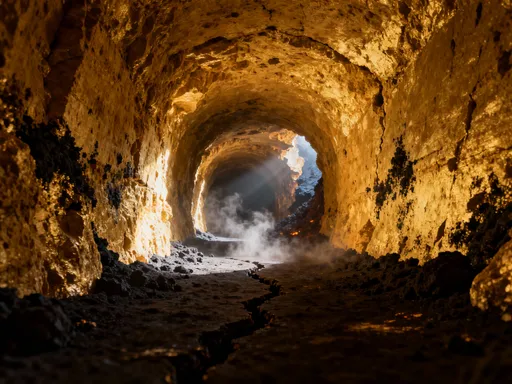
Modern exploration of these underground sites is possible through authorized guided tours offered by local heritage organizations. Visitors descend narrow staircases from street level into cool, dimly lit passages where the air carries a faint earthy scent. The walls, marked by chisel strokes and centuries of moisture, tell stories of craftsmanship and survival. In some areas, remnants of ancient graffiti, oil lamps, and architectural details remain intact, offering tangible connections to the past. These tours emphasize not only historical significance but also geological awareness, explaining how the stability of the tunnels depends on careful maintenance and environmental monitoring.
One of the most remarkable sites is the Napoli Sotterranea, a section of the underground network open to the public since the 1990s. Here, visitors walk through tunnels that once served as quarries feeding construction above, later adapted for wartime shelter during Allied bombings in 1943. Personal artifacts, including bottles, toys, and handwritten notes, were left behind by families who lived underground for weeks. These human traces, preserved in the quiet darkness, evoke a deep emotional resonance, reminding us that geology is not just about rocks and eruptions—it is also about shelter, memory, and endurance.
The Stone That Built a City: Neapolitan Tuff
The identity of Naples is inseparable from the golden-yellow tuff that has shaped its skyline and infrastructure for over two millennia. *Tufo giallo napoletano* is a pyroclastic rock formed during explosive eruptions of the Campanian Ignimbrite, a super-eruption that occurred around 39,000 years ago. This event blanketed southern Italy in volcanic ash, which over time compacted into the soft, workable stone now quarried beneath the city. Its ease of carving made it ideal for construction, allowing artisans to shape everything from humble homes to grand palaces with minimal tools.
This geological gift influenced not only architecture but also urban planning. Because tuff could be excavated vertically as well as horizontally, Neapolitans built multi-level cities—stacking homes, churches, and courtyards atop one another, often connected by hidden stairways and tunnels. Entire neighborhoods, such as those in the historic Rione Sanità district, are constructed directly above vast underground voids. The stone’s thermal properties also contributed to comfort, providing natural insulation against summer heat and winter chill. Even today, many older buildings retain their original tuff walls, sometimes covered in plaster or paint but still structurally vital.
Beyond its practical uses, Neapolitan tuff holds cultural significance. The Catacombs of San Gaudioso and San Gennaro were hewn directly into the rock, serving as burial sites and places of veneration. The softness of the stone allowed for intricate carvings, including loculi (burial niches), frescoes, and devotional altars. These underground cemeteries reflect both religious devotion and engineering ingenuity, demonstrating how faith and geology coexisted in daily life. In more recent times, artists and architects have revisited tuff as a sustainable building material, promoting its use in restoration projects and eco-conscious design.
However, the very qualities that make tuff advantageous also pose challenges. Its porosity makes it vulnerable to water damage and erosion, especially in a city with aging drainage systems and frequent rainfall. Preservation efforts are ongoing, with experts using advanced techniques like laser scanning and micro-reinforcement to stabilize critical structures. Local authorities work closely with geologists to monitor subsidence and prevent collapses, particularly in densely populated areas. The story of Neapolitan tuff is thus one of adaptation—a testament to how a city can thrive by working with, rather than against, its geological foundation.
Coastal Wonders: The Flegrean Coast and Its Shifting Shores
West of Naples, the Phlegraean Fields—known in Italian as *Campi Flegrei*—form a vast volcanic caldera stretching from Monte di Procida to Pozzuoli. Unlike the singular cone of Vesuvius, this area is a broad, simmering system of hydrothermal activity, marked by fumaroles, hot springs, and frequent ground deformation. It is one of the few places on Earth where the phenomenon of bradyseism—the gradual uplift and subsidence of land due to underground pressure changes—is visibly evident over human timescales. In Pozzuoli, ancient Roman market ruins known as the Macellum reveal columns partially submerged in water, their lower sections encrusted with marine life, proving that the land has risen and fallen multiple times over the past two millennia.
The Solfatara crater, located within the Phlegraean Fields, is one of the most accessible sites to witness this activity. Here, visitors walk across a cracked, ashen plain where steam vents release sulfurous gases into the air, creating an otherworldly atmosphere. The ground is warm underfoot, and the scent of rotten eggs—hydrogen sulfide—is unmistakable. Scientists monitor gas emissions and ground movement here daily, as increased activity could signal future unrest. Yet despite the risks, the area attracts thousands of visitors each year, drawn by its geological drama and therapeutic mud baths, long believed to have healing properties for skin and joint conditions.
Along the coast, the effects of bradyseism are even more dramatic. In Baia, an ancient Roman resort town now partially submerged, underwater archaeologists have mapped villas, roads, and statues lying beneath the sea. When the land sinks, these ruins are flooded; when it rises, they re-emerge. This dynamic has created a unique form of heritage preservation—one dictated by geology rather than human intervention. Glass-bottom boat tours and snorkeling excursions allow visitors to view these sunken structures, offering a rare opportunity to see history reshaped by natural forces.
The Phlegraean coast also hosts thermal springs used since Roman times for relaxation and wellness. Towns like Agnano and Lucrino are known for their spa traditions, where mineral-rich waters flow from underground reservoirs heated by magma. Modern facilities combine ancient practices with medical supervision, offering treatments for respiratory and musculoskeletal conditions. These thermal zones exemplify how geological hazards can yield health benefits when managed responsibly. For travelers, the region offers a compelling blend of science, history, and wellness—where the Earth’s inner heat becomes a source of renewal rather than fear.
Island Geology: Procida and Ischia’s Volcanic Contrasts
A short ferry ride from Naples reveals two islands with strikingly different geological personalities. Procida, the smallest of the three major islands in the Gulf of Naples, is characterized by colorful hillside villages perched atop rugged tuff formations. Its landscape was shaped by ancient pyroclastic flows that created layered cliffs and natural harbors. While no longer volcanically active, Procida’s geology supports rich biodiversity and terraced agriculture. The island’s steep slopes, stabilized by dry-stone walls, grow lemons, capers, and grapes—products of soil enriched by millennia of volcanic deposits.
In contrast, Ischia is a still-active volcanic island with over thirty thermal hotspots and evidence of eruptions as recent as the 14th century. Located at the northern edge of the Phlegraean volcanic system, Ischia’s geothermal activity fuels numerous spa resorts and natural steam vents. The island is particularly known for its green obsidian, a rare form of volcanic glass formed when lava cools rapidly with high concentrations of minerals like chromium. Found primarily in the Fango and Citara areas, this shimmering stone has been used in local jewelry and decorative arts for generations.
Ischia’s most famous geological feature is Monte Epomeo, a 788-meter-high mountain that is not a traditional volcano but a “resurgent dome”—a block of crust pushed upward by magma pressure beneath the island. Unlike explosive cones, Epomeo grows slowly, rising several millimeters each year. Hiking trails lead to its summit, offering panoramic views of the Gulf and visible layers of tuff, lava, and ash that record past eruptions. The ascent reveals how different phases of volcanic activity have shaped the island’s terrain, from fertile valleys to rocky outcrops.
Both islands demonstrate how volcanic landscapes evolve differently based on underlying geology and tectonic forces. While Procida offers a glimpse into the long-term stabilization of volcanic terrain, Ischia provides a living example of ongoing thermal activity. For visitors, this contrast enriches the experience, allowing comparisons between dormant and active zones. Ferry connections from Naples make these destinations easily accessible, and local guides offer educational tours that highlight both natural beauty and scientific significance. Together, Procida and Ischia complete the geological portrait of the Gulf, showing how fire and time shape islands in unique ways.
Walking Through Time: Trails That Reveal Earth’s Layers
For those who prefer to explore on foot, the Campanian landscape offers numerous trails where geological history is written in stone. The *Sentiero degli Dei* (Path of the Gods), winding along the Amalfi Coast between Bomerano and Nocelle, is renowned for its breathtaking views—but it also exposes layers of limestone, tuff, and marine sediment that tell a story spanning millions of years. Along the route, hikers can see fossilized seashells embedded in cliff faces, evidence that this area was once submerged beneath an ancient sea. Informative plaques at key points explain the formation of the Apennine Mountains and the role of tectonic uplift in shaping the coastline.
Further inland, the Phlegraean Mountains Regional Park contains a network of lesser-known paths that traverse volcanic craters, forests, and abandoned quarries. The trail to Monte Barbaro, for instance, passes through the crater of an extinct volcano, where wildflowers bloom in soil rich with volcanic minerals. Here, the ground is dotted with small fumaroles, and the air carries a faint warmth. Interpretive panels describe the area’s eruptive history and the ecological recovery that follows volcanic activity. These walks are suitable for all fitness levels and often include rest stops with views of Lake Avernus, a crater lake once believed to be an entrance to the underworld in Roman mythology.
Another compelling destination is the Cava Solfara quarry near Quarto, where exposed rock faces reveal clear stratification from multiple eruptions. Geology tours led by university researchers or certified guides allow visitors to examine ash layers, pumice deposits, and fossilized plant material. These excursions are designed to be accessible to non-specialists, using simple language and hands-on demonstrations to explain complex processes. Participants often leave with a deeper appreciation for how time, heat, and pressure transform landscapes.
These trails do more than offer scenic beauty—they provide experiential learning. By walking through canyons, climbing volcanic slopes, and touching ancient rock, travelers engage with geology in a visceral way. Maps and mobile apps developed by regional parks help visitors navigate safely while highlighting points of scientific interest. Whether hiking alone or with a guide, the experience fosters a sense of connection to the Earth’s rhythms and a respect for the forces that continue to shape our world.
Respecting the Earth: Sustainable Exploration and Local Wisdom
Living in a geologically active region has taught Neapolitans the value of balance. For generations, they have developed practices that acknowledge risk while embracing the benefits of their environment. Thermal baths, agricultural traditions, and architectural techniques are all rooted in a deep understanding of the land. This wisdom is not written in textbooks alone but passed down through families, artisans, and community leaders. Today, as tourism grows, there is increasing emphasis on preserving these fragile systems through sustainable practices and informed visitation.
Local authorities have implemented strict guidelines for accessing sensitive areas. In the Phlegraean Fields, certain zones are closed during periods of elevated seismic activity. Visitors to underground sites must be accompanied by certified guides, and group sizes are limited to minimize environmental impact. Educational programs in schools and museums promote geological literacy, helping residents and tourists alike understand the importance of monitoring and preparedness. These efforts reflect a broader cultural shift toward resilience and stewardship.
Travelers can contribute by choosing responsible tour operators, respecting barriers and signage, and avoiding unauthorized entry into restricted areas. Simple actions—such as staying on marked trails, not removing rocks or fossils, and supporting local conservation initiatives—help protect these wonders for future generations. Learning a few key facts about bradyseism, volcanic monitoring, or tuff conservation can deepen the experience and foster meaningful engagement.
Ultimately, exploring Naples’ geological wonders is not just about sightseeing—it is about cultivating awareness. The land beneath our feet is alive, changing, and powerful. By approaching it with curiosity, respect, and humility, we honor both its beauty and its complexity. In the shadow of Vesuvius, where fire and fertility coexist, visitors find not only adventure but also a profound lesson in harmony with the natural world.